
0.2 Meet the Bible-Study Pathway

Enjoy Discovering the Bible for Yourself
0.2 · Meet the Personal Bible-Study Pathway
Personal Bible Study begins with the Bible text. From there, you learn three core skills: OBSERVATION → INTERPRETATION → APPLICATION. This page gives you the whole map before the course slows each skill down.
I can see where Personal Bible Study begins, name the three core skills, and explain the main movement inside Observation, Interpretation, and Application.
Your tools are ready: device + Bible + PBS Notebook + pen or pencil. You also know the rhythm of reading one instruction, working with the Bible passage, recording your own work, and then continuing.
Now you are asking one question: Where is all this going?
Do not try to memorise every branch today. First see how the parts belong together. Later pages will teach the skills one at a time and give you plenty of practice.
Personal Bible Study Starts with the Bible Text
PBS means learning to study a Bible passage carefully for yourself. It does not mean refusing teachers or helpful resources. It means that the Bible passage gets the first word and remains the place where you check what you are learning.
Read the passage before deciding what it means, before applying it, and before depending on an outside explanation.
Read the Mind Map from the Centre Outward
Begin at PBS PATHWAY in the centre. Then follow the numbered branches. Give special attention to the three core skills: Observation, Interpretation, and Application.
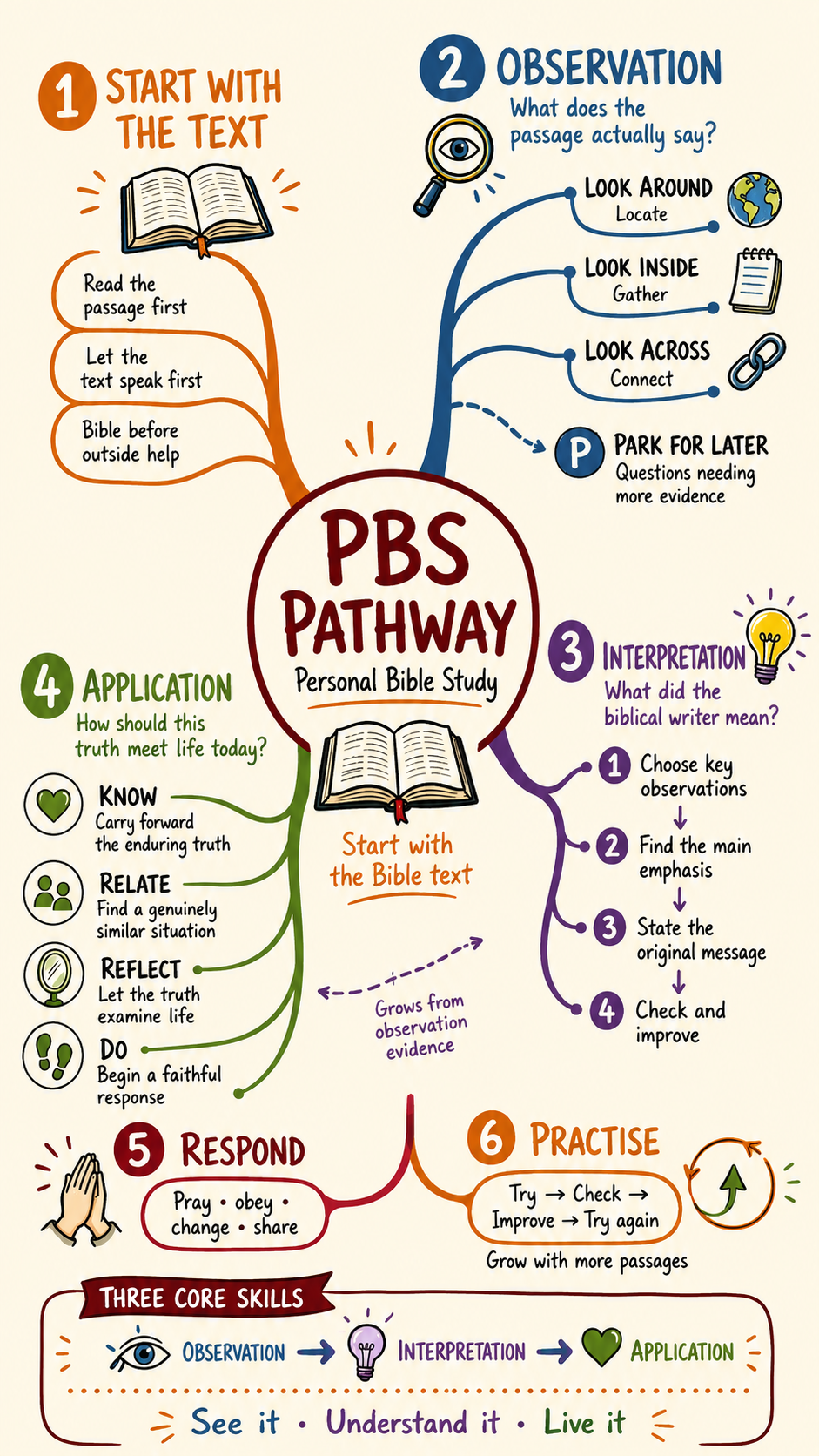
You do not need to copy the whole mind map into your PBS Notebook. Look at how the branches connect, then return to the picture as the course teaches each part step by step.
What Should You Notice in the Mind Map?
Open and read the Bible passage first. The text gives you something real to observe.
Observation uses three ways of looking: LOOK AROUND · Locate, LOOK INSIDE · Gather, and LOOK ACROSS · Connect.
P · PARK FOR LATER is a safeguard for questions that need more evidence. It is not a fourth Observation skill.
Observation gives you the evidence. Interpretation then moves through: Choose Key Observations → Find the Main Emphasis → State the Original Message → Check and Improve.
Application carries the passage-shaped truth faithfully into life through: KNOW → RELATE → REFLECT → DO.
Your response grows from faithful Application. Then you practise the same method with more passages so the skill becomes your own.
OBSERVATION → INTERPRETATION → APPLICATION
See it → Understand it → Live it.
Joel and Meera · Which Branch Comes First?


Joel is preparing a short encouragement for his school fellowship group. Between tuition and homework, he sees a social-media graphic quoting Philippians 4:13: “I can do all things through Christ, who strengthens me.” The caption says, “God will help you achieve anything you want.”
The post sounds encouraging, and Joel is short on time. He is ready to use it. Meera notices the claim, looks at the PBS Pathway mind map, and asks: “Before we decide whether that caption fits Paul’s meaning, where does our pathway tell us to begin?”
Joel follows the first branch: “START WITH THE TEXT. We should read the verses around it first.”
The first branch does not ask Joel to accept or reject the caption immediately. It tells him where to begin: read the Bible passage itself. DO NOT YET: try to give a complete Interpretation.
Optional · Read Philippians 4:10–13 · Notice the Context
The markings help you notice the flow around verse 13. Bible words stay outside brackets. Brackets contain only our added study notes.
10 But [shift] I rejoice in the Lord greatly, that now at length you have revived your thought for me; in which you did indeed take thought, but [contrast] you lacked opportunity.
11 Not that I speak because of lack [clarification], for [reason] I have learned in whatever state I am, to be content in it .
12 I know how to be humbled, and I know also how to abound . In everything and in all things I have learned the secret both to be filled and to be hungry, both to abound and to be in need. [contrasting circumstances]
13 I can do all things through Christ, who strengthens me. [read with verses 11–12]
Verse 13 comes after Paul speaks about contentment, being humbled and abounding, being filled and hungry, and having plenty and being in need. That surrounding text must be considered before deciding what “I can do all things” means.
Philippians 4:10–13 · World English Bible, public domain
What exactly did Paul mean by “I can do all things”? Do not guess yet. You will have better tools for answering that after learning Observation and Interpretation.
Can You Read the Pathway?
Where does PBS begin? · With the Bible text.
What are the three core skills? · Observation, Interpretation, Application.
What are the three Observation looks? · Look Around, Look Inside, Look Across.
Where does Interpretation grow from? · Observation evidence.
What happens after understanding? · Carry the truth faithfully into life, respond, and keep practising.
You can point to the mind map and explain: Start with the Text → Observation → Interpretation → Application, and you know that Response and repeated Practice grow from that pathway.
Now We Slow Down and Learn It Step by Step
Keep the mind map as your big picture. From the next page onward, you will practise the pathway one skill at a time, beginning with the habit that controls everything that follows: START WITH THE TEXT.
Where Should Bible Study Begin? · Start with the Text
EnjoyBible.in · See it. Understand it. Live it.
Enjoy Discovering the Bible for Yourself · Welcome and Course Guide · Page 0.2