
0.3 · Why EnjoyBible Exists

You have heard the dream. You have seen why we believe it matters. Now let us show you how we hope to help that dream become real in the life of an ordinary learner.
A dream like this needs more than inspiration. It needs a learnable pathway.
It is easy to tell someone, “Read the Bible.” You may genuinely want to. But when you open it, very practical questions can appear.
Where do I begin?
How do I know what a passage means?
What should I notice?
How much background do I need?
What if I do not understand something?
How do I apply the Bible without making it say whatever I want?
How do I build a habit that lasts?
Questions like these are part of the reason EnjoyBible began.
We trace the beginning of EnjoyBible back to May 2005. The creator of EnjoyBible sensed a simple phrase being impressed deeply on his heart:
That thought stayed. Over time it grew into a dream: What if more people could discover the joy of opening Scripture, looking carefully, understanding what God has said, and learning to live by it?
That does not mean making the Bible shallow or turning Bible study into entertainment. Some passages are demanding. Some questions take time.
It means helping people experience the joy that comes when they begin to see, understand, and discover God’s Word for themselves.
Over time, that dream also found a simple picture.
Our logo gathers together three things we hope will become part of your own journey with God’s Word.
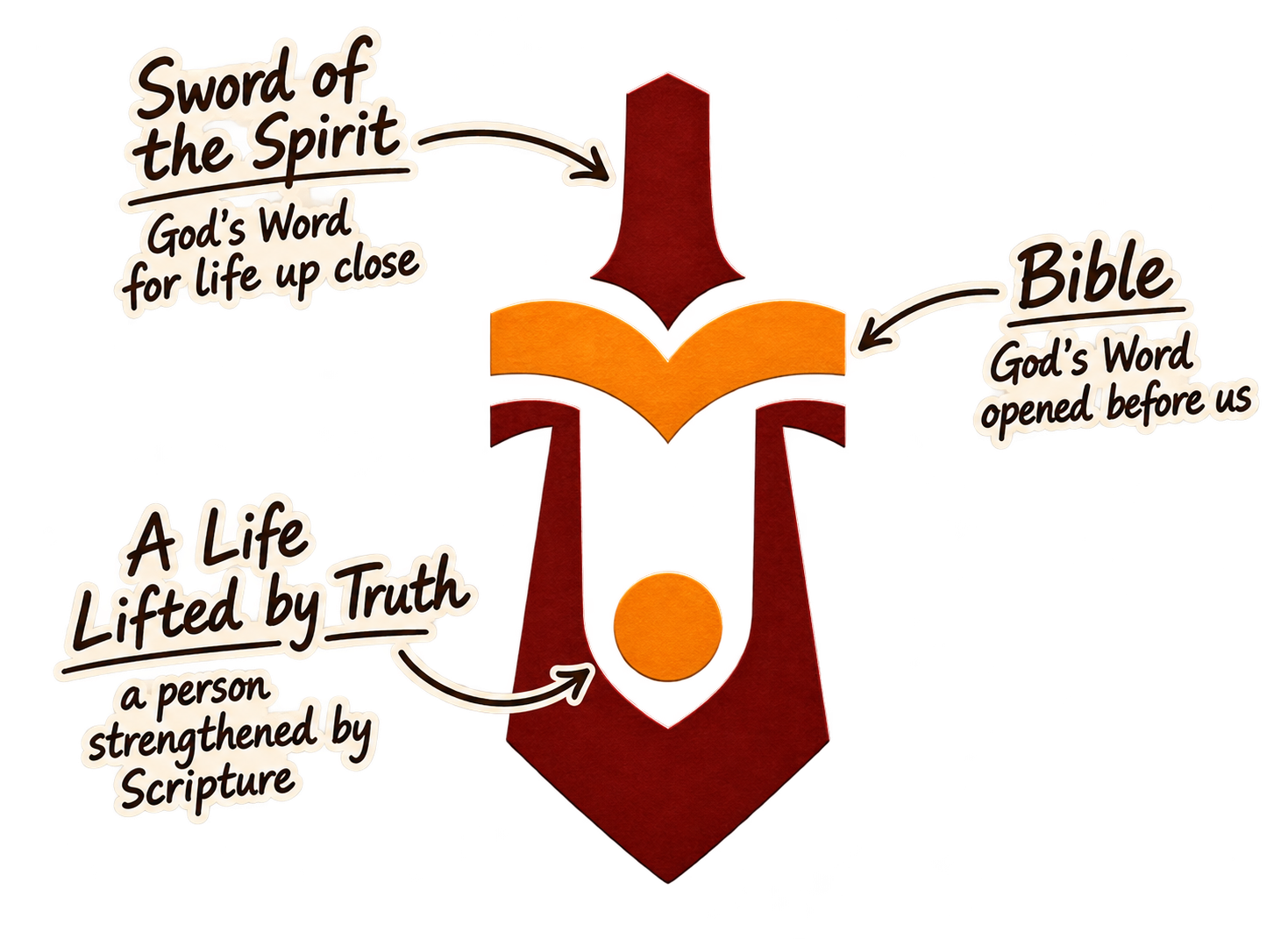
God’s Word opened before us. The journey begins with Scripture itself: opening the text, looking carefully, listening to what it says, and allowing its truth to shape the way we understand life.
The sword handle reminds us of Ephesians 6:17: “Take the sword of the Spirit, which is the Word of God.”
The Greek word machaira can describe a short sword or large knife suited to close-range use. It is a fitting picture of God’s truth coming close to fear, lies, shame, anger, jealousy, doubt, and the choices we make in real life.
The lower part can be seen as a person with lifted hands. It points to a life strengthened by Scripture, growing in courage, worship, and readiness to live what God’s Word teaches.
But a picture is not enough. The dream has to become a way of learning.
A familiar proverb says that giving someone a fish feeds them for a day, while teaching them to fish gives them a skill they can keep using.
Ready-made Bible answers can feel easier. Someone else has already done the thinking, and you can simply read the conclusion. Good explanations have their place.
But if all you ever receive are finished answers, you may never develop the skill of studying Scripture for yourself.
Read.
Look again.
Mark.
Write what you notice.
Compare.
Check the context.
Think.
Revise.
Return to the passage.
Sometimes this takes more effort than reading someone else’s explanation. But that effort is part of learning the skill.
And gradually, something exciting begins to happen: you start noticing things for yourself.
So what are we actually helping you learn? Three core skills.
Across EnjoyBible courses, the learning journey can be gathered into three simple movements.
Slow down and notice what is there: words, repeated ideas, people, actions, contrasts, connections, questions, commands, reasons, and movement in the writer’s thought.
Give the passage the first word.
A verse belongs to a paragraph. A paragraph belongs to a larger section. A section belongs to a biblical book written in a real setting. Learn to follow the writer’s thought and check whether your understanding fits the passage.
We want to understand what Scripture actually says.
Bible study should not end with information. Once a passage is understood faithfully, ask how its truth should shape thinking, choices, habits, relationships, prayer, priorities, and actions.
A faithful response grows from a faithfully understood passage.
Skills grow through practice, so the way we guide you matters too.
Recurring learners bring realistic questions, mistakes, pressures, discoveries, and moments of confusion. Sometimes you will learn from them. Sometimes you may notice something they missed. Their role is to make the journey feel human while keeping the Bible at the centre.
Mind maps and visual guides help you see how ideas connect, where you are in the learning process, what you have already practised, and what comes next. A good map does not do the journey for you. It helps you see the journey.
Many learners study on a phone. Pages are arranged in manageable sections with clear instructions and sensible stopping points so you can pause and return without losing the learning journey.
You will sometimes need to open your Bible, mark something, write, compare, think, revise an answer, or return to the passage.
No spoon-feeding. Plenty of guidance.
Learning for yourself does not mean learning alone. Good help still matters.
Christians learn in community. Pastors, teachers, parents, mentors, study Bibles, commentaries, books, videos, and other resources can all help.
Good help can correct us, deepen our understanding, and show us something we missed. The question is not whether we should use help. The question is how we use it.
Start with the passage.
Look carefully.
Write what you notice.
Think.
Then use good help to check, clarify, and deepen your understanding.
AI can also be useful for explaining unfamiliar words, exploring background, comparing ideas, or helping you check something later.
But if you ask for the meaning before you have looked carefully yourself, you may receive an answer without developing the skill.
Let tools support your discovery rather than taking the discovery away from you.
As you keep practising, the goal is not greater dependence on EnjoyBible. It is greater confidence with an open Bible.
At first, you may need many prompts, examples, and reminders. That is normal. We hope to walk beside you for a while.
You begin to know how to open a passage.
You begin to notice what matters.
You begin to ask better questions.
You learn to check the context.
You learn to test whether an explanation fits the passage.
When something is difficult, you know how to keep looking and where to find good help.
EnjoyBible is a guide along the way. It is not meant to replace Scripture, the Holy Spirit, the local church, Christian fellowship, pastors and teachers, parents and mentors, or personal prayer.
The dream was never to make you dependent on EnjoyBible. The dream is to help you become a person who knows how to open the Bible and discover God’s truth for yourself.
One student.
One open Bible.
One passage read carefully.
One truth understood faithfully.
One honest response to God.
Then another passage. And another. Little by little, God’s Word begins to shape the way you think, choose, study, work, serve, and live.
That is how a generation with open Bibles begins. It begins with someone opening one.
Now you know what we hope to help you learn and how we will walk with you.
The next question is simple: where should you begin?